He Was Born Property. He Died a Founder.
There's a particular kind of audacity that only comes from having nothing to lose. John Mercer Langston understood that audacity better than almost anyone in nineteenth-century America. Born in 1829 in Louisa County, Virginia, to an enslaved woman named Lucy Langston and a white plantation owner named Ralph Quarles, he arrived in a world that had already decided what he was worth — and it wasn't much.
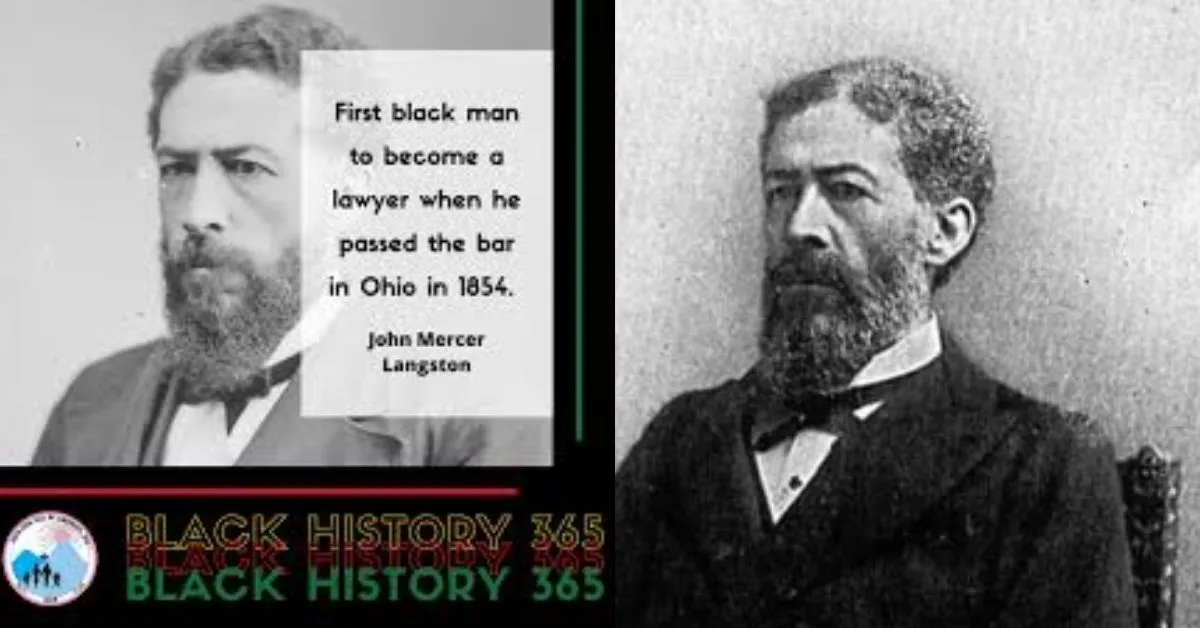 Photo: John Mercer Langston, via silentnews.org
But Quarles did something unusual. When he died, he freed Langston, left him a modest inheritance, and sent him north. Langston was four years old. His mother was already gone. He had no surname the law recognized, no community to return to, and no roadmap for what came next.
What he built from that starting point is one of the most quietly staggering stories in American history.
A Name Chosen, Not Given
Langston's early years were spent in Ohio, shuffled between guardians, absorbing every scrap of education he could find. He was bright in the way that makes teachers nervous — the kind of student who doesn't just learn the lesson but questions why it was taught that way in the first place.
By his early twenties, he had been rejected from multiple law schools on account of his race. He studied independently, passed the Ohio bar in 1854, and became one of the first Black men licensed to practice law in the United States. He didn't celebrate. He got to work.
That's the thing about Langston that gets lost in the broader sweep of Reconstruction-era history. He wasn't interested in being a symbol. He was interested in building things that lasted.
When Banks Wouldn't Serve You, You Built Your Own
The financial landscape facing Black Americans in the mid-nineteenth century wasn't just unequal — it was deliberately designed to exclude. Banks wouldn't open accounts. Credit was inaccessible. Wealth accumulated nowhere because nowhere was safe.
Langston recognized early that political freedom without economic infrastructure was a hollow promise. You could vote on Tuesday and still be turned away from a loan on Wednesday. That gap — between legal rights and practical power — became the territory he decided to occupy.
His work with the Freedmen's Bureau brought him into direct contact with the scale of the problem. Hundreds of thousands of formerly enslaved people were entering a free market with no tools, no capital, and no institutions that would serve them. Langston helped channel resources, establish legal frameworks, and push for the kind of financial structures that could convert emancipation from a legal fact into a lived reality.
He understood something that many of his contemporaries missed: institutions are the real currency of power. Laws change. Political winds shift. But a bank, a school, a professional organization — those things have weight. They outlast the people who build them.
The Dean Who Built a Law School From Scratch
In 1869, Langston became the first dean of Howard University's School of Law in Washington, D.C. He didn't inherit a functioning institution. He built one — recruiting faculty, designing curriculum, and turning a concept into a place where Black men and women could become lawyers at a time when that was still a radical act.
 Photo: Howard University, via logos-world.net
His tenure at Howard lasted nearly a decade, and the school he shaped became a pipeline for Black legal talent that would eventually produce Thurgood Marshall, among others. The ripple effect of that single institution on American civil rights history is almost incalculable.
But Langston wasn't done.
The Congressman They Tried to Erase
In 1888, Langston ran for Congress from Virginia — the same state where he had been born into bondage. He won. His opponent disputed the results, and Congress initially seated the other man. Langston fought the challenge for nearly two years before the House of Representatives finally ruled in his favor and seated him in September 1890.
He served the remainder of the term. It wasn't long. But the symbolism of a man born legally enslaved in Virginia standing as its elected representative in the United States Congress is the kind of thing that doesn't require embellishment.
He also founded what is now Virginia State University — another institution built not for prestige but for survival, for access, for the unglamorous work of giving people the tools to navigate a world that had been arranged against them.
 Photo: Virginia State University, via 1.bp.blogspot.com
What Langston Actually Teaches Us
The instinct, when telling a story like Langston's, is to reach for the word "inspiring" and leave it there. But that undersells what he actually did.
Langston's life wasn't a story about individual triumph against the odds. It was a story about institutional logic — about understanding that lasting change requires structures, not just moments. Every school he founded, every legal framework he helped establish, every political office he won and held was a brick in something larger than himself.
He was working on a construction project that he knew he wouldn't live to see completed. And he built anyway.
In an era when Black Americans were being systematically stripped of the gains of Reconstruction — when banks were closing, voting rights were being suppressed, and the promises of the postwar years were curdling into something much darker — Langston kept building. Not out of optimism, exactly. Out of the conviction that the alternative was worse.
He was born with nothing that the law recognized as his. He spent his life making things that couldn't be taken away.
That's not inspiration. That's architecture. And some of it is still standing.