The Boy the Navy Wanted to Forget: How America's Youngest Combat Veteran Refused to Disappear

The Boy the Navy Wanted to Forget: How America's Youngest Combat Veteran Refused to Disappear
The Navy gave Calvin Graham a Bronze Star and a Purple Heart. Then it took them back. Then it threw him in the brig. Then it gave him a dishonorable discharge. Then, for good measure, it cut off his pension and spent decades pretending he barely existed.
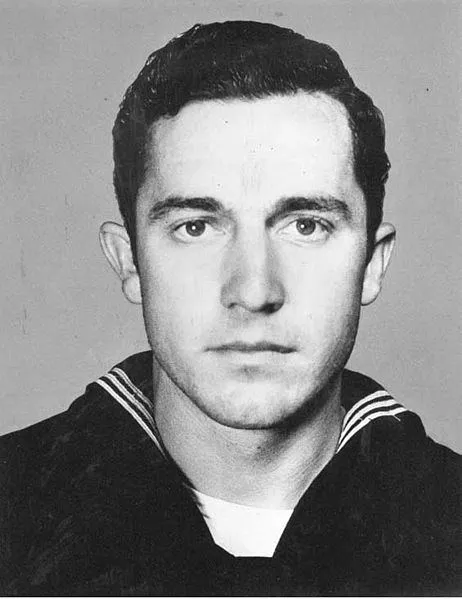 Photo: Calvin Graham, via alchetron.com
All of this because he had been twelve years old when he enlisted.
Calvin Graham's story is the kind that should be famous — the kind that gets made into a movie, taught in schools, put on a monument somewhere in Texas. Instead, it spent decades buried under bureaucratic embarrassment, surfacing only in fragments until a CBS television movie in 1981 finally gave it the audience it deserved. Even then, the full weight of what happened to this boy — and what he had to fight to recover — rarely gets told straight.
This is an attempt to tell it straight.
Running From Something Worse Than War
Calvin Leon Graham was born on April 3, 1930, in Canton, Texas, the sixth of seven children. By the time Pearl Harbor was attacked in December 1941, he was eleven years old and living in Houston with a mother who had remarried a man Calvin later described as abusive. Home was not safe. The war, paradoxically, looked like an exit.
He spent months working on his plan. He shaved — though there was nothing to shave — practiced lowering his voice, and obtained forged documents suggesting he was seventeen. In August 1942, he walked into a Navy recruiting station in Houston and enlisted. He was twelve years and four months old.
The recruiter either didn't look closely enough or didn't want to. Calvin Graham became a sailor.
Guadalcanal
He was assigned to the USS South Dakota, a battleship that would see some of the heaviest action of the Pacific campaign. In November 1942, during the Naval Battle of Guadalcanal, the South Dakota came under intense Japanese fire. Calvin Graham was on deck when the ship was hit.
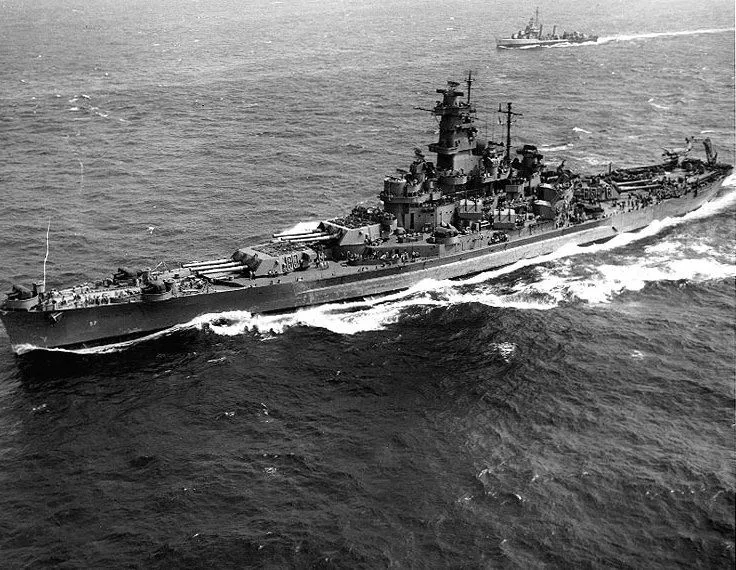 Photo: USS South Dakota, via www.thoughtco.com
The accounts of what he did during those hours are remarkable and, by multiple witnesses' reports, genuine. He pulled wounded sailors from the water. He helped carry men below decks. He kept moving when others couldn't. And then he was hit — shrapnel tore through his jaw, and he spent time in the water himself before being pulled aboard.
He was fourteen years old.
When his mother wrote to the Navy to report that her underage son was serving in a combat zone, the Navy's response was swift and, by any reasonable measure, shameful. They pulled Graham from service, stripped him of his medals, and charged him with fraudulent enlistment. He was sentenced to three months in a military prison — the brig — and given a dishonorable discharge that denied him veterans' benefits.
Let that sit for a moment. A fourteen-year-old boy who had survived a naval battle, pulled wounded men from the water, and taken shrapnel to the face was thrown in a military prison and dishonorably discharged.
The Long Fight for What Was His
Graham got out of the brig, went back to Texas, and tried to build a life. He worked in construction, eventually becoming a skilled draftsman. He married. He had children. He didn't talk much about what had happened.
But the injustice of it didn't go away, and neither did the practical consequences. Without veterans' benefits, Graham couldn't access the medical care he needed for injuries that traced directly back to his service. His jaw had never healed properly. His body carried the war in ways the government refused to acknowledge.
In the 1970s, he started fighting back — writing letters, contacting congressmen, pushing the story into whatever public space would take it. The CBS movie in 1981, Too Young the Hero, brought national attention. Congressional pressure followed. In 1988, Congress passed legislation specifically addressing Graham's case, restoring his honorable discharge and his medals — though his pension was only partially restored, and the fight over full benefits continued until nearly the end of his life.
He died in 1992 at sixty-two, still pushing.
What the Bureaucracy Was Actually Protecting
It would be easy to frame what happened to Calvin Graham as a simple clerical error — a kid slipped through the system, the system corrected itself eventually, end of story. But that's not what happened.
What happened was that the United States Navy accepted the service of a child, benefited from that service under combat conditions, and then, when his age became inconvenient, punished him for the very deception it had failed to catch. The dishonorable discharge and the stripped medals weren't about justice. They were about institutional embarrassment. The Navy didn't want a twelve-year-old war hero on its record. It wanted the story to disappear.
And for a long time, it nearly succeeded.
Graham's decades-long campaign to recover his own history is, in some ways, as remarkable as the combat service itself. He wasn't fighting a foreign enemy. He was fighting paperwork, indifference, and the particular cruelty of a bureaucracy that had decided his story was inconvenient. He did it without lawyers, mostly without money, and with the stubborn conviction that what had happened to him was wrong and that saying so out loud, repeatedly, was the only tool he had.
The Youngest and the Longest
Calvin Graham is believed to be the youngest American to serve in World War Two — a distinction that should carry weight, that should have meant something to the institution that sent him into battle. Instead, it took more than four decades for that institution to fully acknowledge what it owed him.
His story belongs in the same conversation as the Tuskegee Airmen, the Nisei soldiers of the 442nd, and every other chapter of American military history where extraordinary service was met with institutional betrayal. It's a story about courage, yes. But it's also a story about what happens when the government decides a person's history is less important than its own reputation.
Calvin Graham refused to let them win that argument. He spent his life insisting on the truth of his own experience — that he had been there, that he had served, that he had bled, and that no discharge paper could change any of it.
He was right. And it cost him almost everything to prove it.