While America Slept: The Quiet Hours Where History Got Made
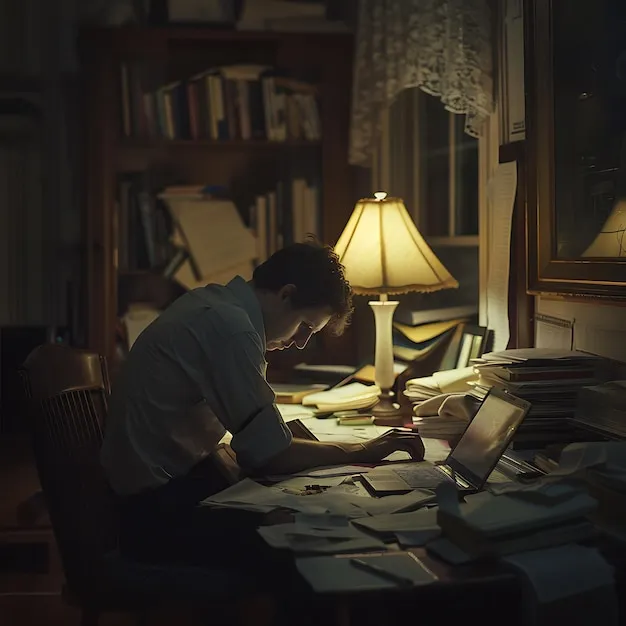
Photo: person working late at night desk lamp dark room, via img.freepik.com
There's a particular kind of silence that falls over America around 2 a.m. The traffic thins. The emails stop. The demands of the day go quiet — and for a certain kind of person, that's exactly when the real work begins.
History has a funny habit of crediting the daylight hours. We picture the boardroom, the lab, the stadium under Friday night lights. But dig into the origin stories of some of the country's most consequential breakthroughs, and you keep finding the same thing: a clock well past midnight, a room with nobody in it but the person doing the work.
The Janitor Who Mapped the Heavens
Henrietta Leavitt didn't get to be an astronomer. In the 1890s, Harvard wouldn't hand a woman a telescope, so she was hired as a human computer — copying and cataloging star measurements for pennies an hour. But the daytime belonged to the men with titles. The evenings, and the quiet corners of her life, belonged to her.
Working through the plate archives on her own time, Leavitt noticed something the famous men had missed: a pattern in how certain stars brightened and dimmed. That pattern — the period-luminosity relationship — became the yardstick Edwin Hubble used to prove the universe was expanding. The man got the telescope named after him. The woman who made the measurement possible got there by working when nobody thought her work counted.
The Night Bus Novelist
Fast forward a century and the setting changes, but the clock doesn't. Before she was one of the most celebrated novelists alive, Toni Morrison wrote her first book in stolen hours — early mornings before her small children woke, evenings after a full day as an editor in New York. She has said she wrote because the quiet was the only space she had left.
She's not alone. John Cheever famously dressed in a suit, rode the elevator down from his Manhattan apartment, and wrote in a basement storage room in his underwear — not because of some eccentric ritual, but because that windowless hour was the only one that belonged entirely to him. The pattern repeats across generations: the day takes everything, and the work survives in the margins.
The Garage That Never Slept
American business has its own night-shift mythology, and most of it is earned. Steve Wozniak designed the motherboard that became the Apple I in a blur of all-nighters, sketching circuits at his job at HP during the day and refining them into the dark hours. The personal computer revolution — the one that reshaped everything from how we bank to how we date — wasn't born in a corporate lab with a budget. It was born at a workbench at midnight, fueled by pizza and the specific joy of building something nobody asked for.
There's a reason for this. Daytime work comes with an audience. An audience brings committees, second-guessing, the gravitational pull of what's already acceptable. The night strip-tests all of that away. What's left is just you and the problem.
Why the Dark Hours Do the Heavy Lifting
Psychologists have a partial explanation: when the brain is a little tired, it stops filtering as aggressively. The internal editor clocks out. That's terrible for spreadsheets and wonderful for connecting two ideas that have no business touching. Plenty of writers and inventors have described the same sensation — the 3 a.m. solution that seemed obvious only because nothing was standing in its way.
But there's a second, less quoted ingredient: obscurity. Nobody works the night shift expecting applause. The people who do this work are doing it because they can't not. That purity is rare, and it tends to produce things that committees can't.
The Pattern Worth Stealing
None of this means you need to wreck your sleep to chase a dream. The lesson isn't the hour — it's the condition. Leavitt, Morrison, and Wozniak all found a space where no one was watching, no one was grading, and no one had permission to say no.
If your days are consumed — by a job, by kids, by the sheer noise of being a person in America in this century — that's not the disqualifier you think it is. Some of the most important work in this country's history was made by people with day jobs, in rooms no bigger than a garage, while the rest of the nation slept.
The quiet hours are still there. They're waiting.