From Scrapyard Dreams to Billion-Dollar Splash: The NASA Engineer Who Conquered Summer
The Sound That Started Everything
It was 1982, and Lonnie Johnson was hunched over his bathroom sink, wrestling with a prototype heat pump that refused to cooperate. The NASA engineer had been pulling double duty—rocket science by day, inventor by night—when a pressurized nozzle he'd been adjusting suddenly erupted. Water blasted across his bathroom with shocking force, soaking the walls and leaving Johnson staring at what would become a billion-dollar accident.
Most people would have grabbed a towel. Johnson grabbed a notebook.
Building Rockets From Junk
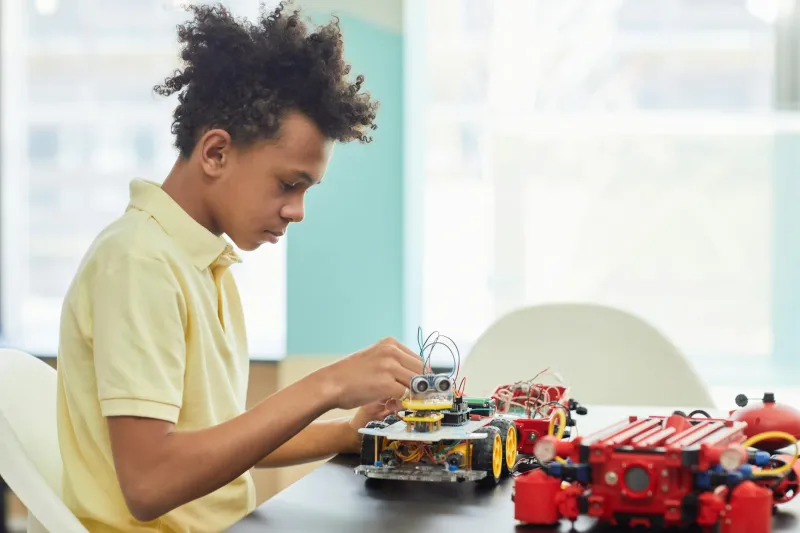
The path to that bathroom breakthrough began decades earlier in Mobile, Alabama, where young Lonnie was already showing signs of the restless creativity that would define his career. While other kids played with store-bought toys, Johnson was in his family's backyard, constructing robots from discarded car parts and electrical components he'd salvaged from anywhere he could find them.
This wasn't just childhood tinkering—it was survival through innovation. Growing up in the segregated South of the 1950s and 60s meant that opportunities for a Black kid interested in science were scarce. But Johnson's parents, both educators, had instilled something crucial: the belief that intelligence could open doors that society tried to keep closed.
By high school, Johnson wasn't just building gadgets—he was winning science fairs with inventions that would have impressed college engineering departments. His robot, constructed entirely from salvaged materials, took first place in a statewide competition, earning him recognition and, more importantly, confidence that his unconventional approach to problem-solving had real value.
From Segregation to Space
College at Tuskegee University opened new worlds, but Johnson's real education came through persistence and pattern recognition. He learned to see solutions where others saw obstacles, a skill that would serve him well when he landed at NASA's Jet Propulsion Laboratory in the early 1970s.
At JPL, Johnson wasn't just another engineer—he was working on projects that pushed the boundaries of what was possible. Stealth bomber technology. Space missions. Systems that had to work perfectly the first time, every time, because there were no second chances when you were dealing with multimillion-dollar spacecraft or military aircraft.
But even as he was helping design some of the most advanced technology on Earth, Johnson's mind kept wandering to that bathroom experiment. The pressurized water blast had revealed something interesting about fluid dynamics and energy transfer. What if that principle could be applied to something... fun?
The Toy Nobody Wanted
Turning a bathroom accident into a marketable product proved harder than rocket science. Johnson spent years refining his water gun concept, creating prototypes that could shoot streams of water with unprecedented accuracy and distance. He knew he had something special, but convincing the toy industry was another matter entirely.
The first meetings were brutal. Toy executives looked at this NASA engineer with his advanced degree and space program credentials, then looked at his water gun, and couldn't reconcile the two. Why would someone qualified to design spacecraft waste time on children's toys? The implicit message was clear: serious inventors didn't play around with squirt guns.
Johnson faced rejection after rejection, often from companies that seemed more interested in his race than his resume. The toy industry in the 1980s wasn't exactly known for its diversity, and a Black inventor pitching a water gun—no matter how innovative—faced skepticism that had nothing to do with engineering and everything to do with assumptions about who gets to be taken seriously in corporate boardrooms.
The Breakthrough That Changed Summer
Everything shifted when Johnson finally connected with Larami Corporation, a small toy company willing to look past preconceptions and focus on performance. When they tested Johnson's prototype—which he'd dubbed the "Power Drencher"—the results were undeniable. This wasn't just another squirt gun; it was a precision water delivery system that could outperform anything else on the market.
Larami licensed the design and rebranded it as the "Super Soaker," launching one of the most successful toy campaigns in American history. The first year alone generated $200 million in sales, and Johnson's invention went on to become the best-selling water gun of all time, generating over $1 billion in retail sales.
Suddenly, the same industry that had dismissed Johnson was scrambling to understand how they'd missed such an obvious hit. The answer was simple: they'd been looking at the inventor instead of the invention.
Beyond the Splash
The Super Soaker's success did more than make Johnson wealthy—it gave him the credibility and capital to pursue other innovations on his own terms. He founded Johnson Research and Development, focusing on everything from advanced battery technology to environmental solutions.
But perhaps more importantly, Johnson's story became proof that genius doesn't always announce itself in expected ways. Sometimes it shows up as a NASA engineer tinkering in his bathroom, turning an accidental water blast into summer magic for millions of kids.
The boy who built robots from scrap metal in segregated Alabama had conquered both outer space and backyard warfare, proving that the most unlikely beginnings often lead to the most extraordinary destinations. In Johnson's case, the journey from junkyard dreams to billion-dollar splash showed that innovation doesn't discriminate—but sometimes, unfortunately, the people who control the purse strings do.
Until, of course, the results become impossible to ignore.