
The Crime of Independent Thought
Elizabeth Packard made a fatal mistake in 1860: she disagreed with her husband in front of other people. Not about money, not about family—about religion and politics. In the parlor of their Illinois home, she dared to express opinions that contradicted Theophilus Packard's rigid Presbyterian beliefs. Within weeks, she found herself locked in the Jacksonville State Hospital for the Insane, committed by a husband who needed only his signature to make her disappear.
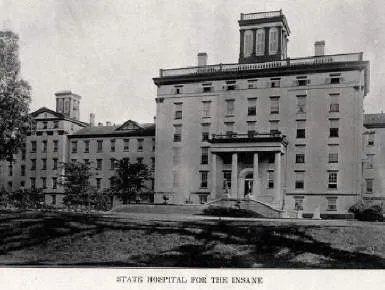 Photo: Jacksonville State Hospital for the Insane, via i.pinimg.com
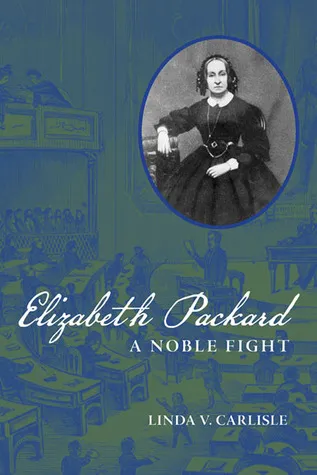 Photo: Elizabeth Packard, via images-na.ssl-images-amazon.com
Under Illinois law, married women had no more legal standing than children. A husband could institutionalize his wife without evidence, without trial, without her consent. Elizabeth's "insanity" was nothing more than intellectual independence, but that was enough to steal three years of her life.
Inside the Machine
The asylum wasn't a hospital—it was a warehouse for inconvenient people. Elizabeth found herself surrounded by women whose only crime was thinking differently than their husbands wanted them to think. Some had questioned their spouse's business decisions. Others had expressed political opinions. A few had simply grown tired of being treated like property.
The conditions were deliberately degrading. Patients were denied basic necessities, subjected to experimental treatments, and punished for any sign of resistance. The message was clear: conform or suffer. Most women broke under the pressure, accepting their fate and emerging as hollow versions of their former selves.
Elizabeth refused to break. Instead, she began documenting everything she witnessed. She smuggled out letters detailing the abuse, the arbitrary punishments, the complete absence of actual medical care. More importantly, she started organizing the other patients, teaching them that their imprisonment was political, not medical.
The Great Escape
Elizabeth's liberation came not through legal channels but through public pressure. Her smuggled letters had reached sympathetic ears, and a small group of reformers began questioning her commitment. When the asylum finally released her in 1863, she emerged with something more valuable than freedom—she had a mission.
Theophilus had expected to retrieve a broken, compliant wife. Instead, he found a woman who understood exactly how the system worked and was determined to destroy it. Elizabeth refused to return home, instead taking her children and beginning a legal battle that would consume the rest of her life.
Building a Movement from Nothing
With no money, no legal training, and no political connections, Elizabeth began the impossible task of changing laws that had existed since the founding of the republic. She started by writing her story, publishing "Modern Persecution" in 1864. The book became a sensation, revealing to American women just how precarious their legal position really was.
Elizabeth didn't just write—she traveled. Using money earned from book sales, she crisscrossed the country, speaking to women's groups, legislative committees, and anyone willing to listen. Her message was simple but revolutionary: married women were citizens, not property, and should be treated as such under the law.
The work was exhausting and often dangerous. Elizabeth faced hostile audiences, death threats, and constant financial pressure. Many of the women she tried to help were too frightened to support her publicly. But she persisted, building a network of supporters one conversation at a time.
Rewriting the Rules
Elizabeth's greatest victory came in Illinois, where she successfully lobbied for passage of the "Bill for the Protection of Personal Liberty." The 1867 law required jury trials for all commitment proceedings and gave patients the right to legal representation. It was the first legislation of its kind in American history.
But Elizabeth wasn't finished with one state. She spent the next two decades traveling from capital to capital, working with local reformers to pass similar protections. Her strategy was methodical: identify sympathetic legislators, provide them with documented evidence of abuse, and mobilize public pressure through speaking tours and media coverage.
By the 1880s, more than thirty states had passed laws based on Elizabeth's Illinois model. The arbitrary power of husbands to institutionalize their wives had been broken, replaced by legal protections that recognized women as independent human beings.
The Personal Cost of Public Victory
Elizabeth's crusade came at enormous personal cost. She never reconciled with Theophilus, who spent years trying to have her recommitted. Her children grew up largely without her, as she traveled constantly for her reform work. She lived in poverty for much of her later life, having spent her book earnings on travel and advocacy.
Yet Elizabeth never expressed regret about the path she chose. In her mind, the alternative—accepting her husband's authority and living as his property—was a form of death. She had chosen to fight not just for herself, but for every woman who might face the same fate.
Revolution in Disguise
What Elizabeth accomplished was nothing less than a revolution in American law and culture. She had taken the system that tried to erase her and forced it to acknowledge women as full human beings. Her work laid the groundwork for later advances in women's rights, from property ownership to voting rights to reproductive freedom.
The woman who was locked away for thinking had used her confinement to understand exactly how oppression worked—and then systematically dismantled it. Elizabeth Packard proved that sometimes the greatest act of rebellion is simply refusing to disappear.
Her legacy lives on in every legal protection that prevents arbitrary commitment, every law that recognizes women's autonomy, every court decision that treats marriage as a partnership rather than ownership. Elizabeth turned her husband's ultimate betrayal into America's gain, transforming personal injustice into public liberation.