Kitchen Tables and Backyard Hoses: The Accidental Birthplaces of America's Favorite Inventions
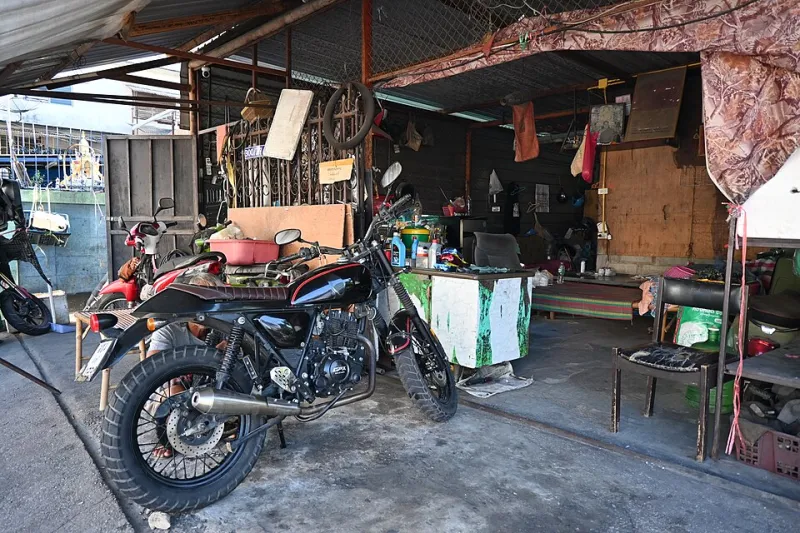
Photo: PattayaPatrol, CC BY-SA 4.0, via Wikimedia Commons
We like to imagine invention as a formal affair. White coats. Venture capital. A gleaming campus in California where brilliant people are paid to think big thoughts.
Then you look at the actual origin stories of the objects Americans can't live without, and a different picture emerges: a kitchen counter, a garage workbench, a moment of improvisation by someone who wasn't trying to change the world at all.
Innovation, it turns out, doesn't check credentials. It just checks whether you noticed.
The Cookie That Was a Mistake
Start with dessert. In the 1930s, Ruth Wakefield was running the Toll House Inn in Whitman, Massachusetts, feeding travelers on the road between Boston and Cape Cod. One day — the story goes — she was making her standard butter drop cookies and found herself without baker's chocolate. She chopped up a Nestlé semisweet bar instead, assuming it would melt into the dough.
It didn't. It softened into pockets of chocolate, and the Toll House cookie became a sensation. Nestlé's sales of semisweet bars near the inn reportedly spiked so dramatically that the company struck a deal: her recipe printed on the package, plus a lifetime of chocolate. That deal put the chocolate chip cookie on virtually every kitchen table in America — and it was born from a missing ingredient.
A Heartbeat Saved by a Component in a Drawer
Now something with higher stakes. In 1956, Wilson Greatbatch, an assistant professor and tinkerer in Buffalo, New York, was building a device to record heart sounds when he grabbed the wrong resistor from his supply box. The circuit started producing a rhythmic electrical pulse — beep, beep, beep — that sounded exactly like a heartbeat.
A lesser man would have tossed the mistake in the trash. Greatbatch sat with it. If a circuit could mimic a heartbeat, could one regulate a failing one? Two years of building prototypes in a barn behind his house followed, often using components donated or scrounged. In 1960, his implantable pacemaker kept a patient alive. Millions of heartbeats later, the device traces straight back to a part grabbed by mistake.
Water, Under Pressure
Lonnie Johnson was a NASA engineer working on a heat pump that used water instead of Freon when he attached a nozzle to his bathroom sink and shot a powerful stream of water across the room. Most people would mop up and move on.
Johnson — who had already worked on the Galileo mission to Jupiter — spent years developing the idea nights and weekends, finally partnering with a toy company. The Super Soaker went on to sell hundreds of millions of dollars' worth, becoming one of the best-selling toys of all time and a fixture of every American summer. A rocket scientist's side project, born in a bathroom, won a water fight.
The Garage Is the Real R&D Department
The list keeps going. The cheeseburger's rise traces to teenage short-order cooks improvising. Post-it Notes came from a 3M scientist who made a weak adhesive — a failure — and watched a colleague's hymn bookmarks keep falling out of his choir book. The trampoline started as a teenager hauling scrap iron and a canvas mat into his parents' yard.
Notice what these stories have in common. Nobody had a mandate. Nobody had a lab. What they had was curiosity plus proximity to a problem — a cookie that needed finishing, a hymn book that needed a bookmark, a sink nozzle that deserved a second look.
The Opinion Part: Stop Waiting for the Lab
Here's where I'll plant a flag. Our culture has convinced itself that innovation belongs to the credentialed — that the next big thing must come from somewhere official, with a pitch deck and a Series A. It's a convenient belief for institutions and a dispiriting one for everyone else.
The evidence says otherwise. The pacemaker was a barn. The Super Soaker was a bathroom. The cookie was an empty pantry. The barrier to entry for changing the world has never been lower than it is right now — a laptop, a garage, a kitchen table, a 3D printer in the corner of the library.
Somewhere in America tonight, someone is grabbing the wrong part and noticing what it does. Someone is improvising a fix for a problem only they've noticed. They don't have funding or permission, and that's exactly why they'll try it.
The next thing in the Smithsonian is probably sitting on a kitchen table right now, unrecognized, waiting for whoever's curious enough to pick it up. It might as well be yours.