The Girl Who Counted Everything
Katherine Coleman was four years old when she started counting. Not just numbers—everything. Steps to the church, dishes on the table, stars visible through her bedroom window in White Sulphur Springs, West Virginia. Her parents, Joshua and Joylette Coleman, watched their daughter's obsession with mathematics with a mixture of pride and concern. In 1920s West Virginia, being a gifted Black girl was both a blessing and a burden.
 Photo: White Sulphur Springs West Virginia, via 1.bp.blogspot.com
The blessing was obvious: Katherine possessed a mathematical mind that could solve complex problems faster than most adults. The burden was equally clear: Greenbrier County had no high school for Black students. If the Colemans wanted their daughter to continue her education, they would have to find another way.
When Determination Drove 120 Miles Daily
Joshua Coleman made a decision that would change American history. Every school day, he drove Katherine and her siblings 120 miles round trip to Institute, West Virginia, where West Virginia State College operated a laboratory high school for Black students. The family rented a small apartment in town during the school year, with Joshua commuting back to his job as a farmer and handyman.
This wasn't just parental sacrifice—it was an investment in a future that most people couldn't imagine. In a state where Black women were expected to become teachers or domestic workers, the Colemans were betting everything on their daughter's extraordinary mind.
Katherine didn't disappoint. She skipped grades, devoured mathematics textbooks, and graduated from high school at fourteen. By eighteen, she had earned degrees in mathematics and French from West Virginia State College, graduating summa cum laude. But in 1937, even mathematical genius had limited career options for a Black woman in America.
The Computers Were Human
Katherine spent her early career teaching, following the expected path for educated Black women. But in 1953, she heard about something unprecedented: the National Advisory Committee for Aeronautics (NACA, later NASA) was hiring Black women as "computers"—human mathematicians who performed the complex calculations needed for aeronautical research.
The job was at Langley Memorial Aeronautical Laboratory in Virginia, where Katherine joined a segregated group of Black women mathematicians working in the West Area Computing unit. They were brilliant, educated, and largely invisible—relegated to a separate building with separate bathrooms and separate cafeterias.
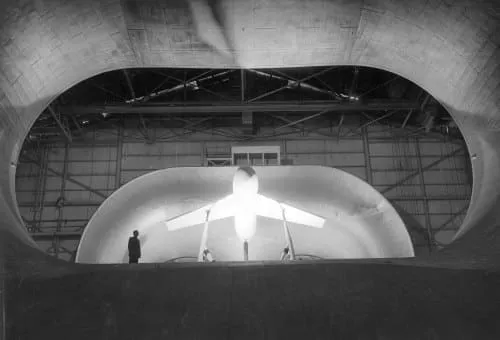 Photo: Langley Memorial Aeronautical Laboratory, via www.citybiz.co
Katherine's colleagues called her "the girl who loved to ask questions." While others accepted assignments without comment, she wanted to understand not just what calculations to perform, but why they mattered. This curiosity would prove to be her secret weapon.
When Machines Couldn't Be Trusted
By the late 1950s, IBM computers were beginning to replace human calculators. Most of Katherine's colleagues worried about obsolescence, but Katherine saw opportunity. The early computers were notoriously unreliable, prone to errors that could mean the difference between mission success and catastrophic failure.
When NASA began planning John Glenn's orbital mission in 1962, the stakes couldn't have been higher. The Soviet Union had already put a man in space, and America desperately needed a successful response. The IBM computers had calculated Glenn's trajectory, but the astronaut himself wasn't satisfied. He specifically requested that Katherine Johnson double-check the machine's math.
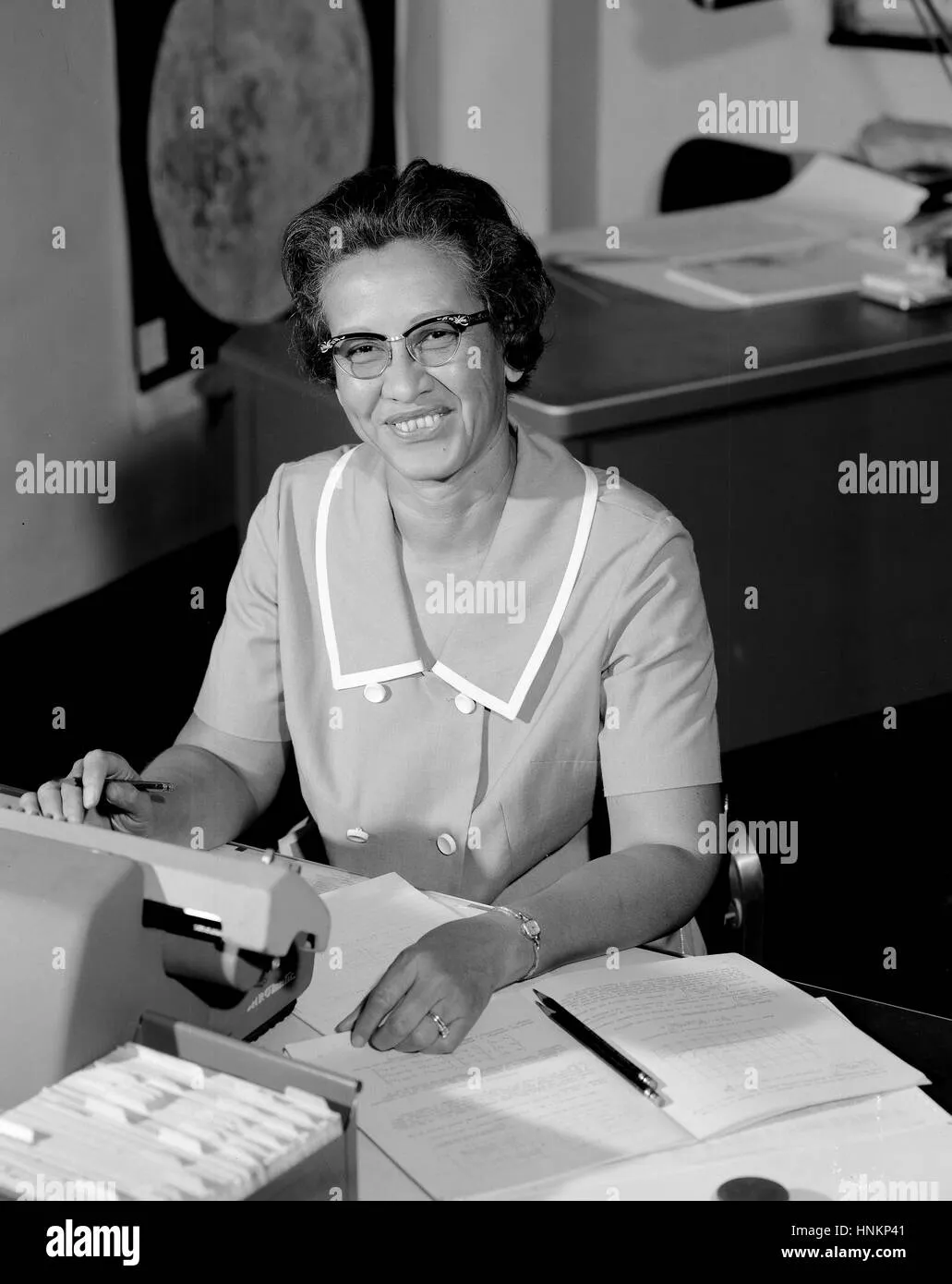 Photo: Katherine Johnson, via c8.alamy.com
"Get the girl," Glenn reportedly said, referring to Katherine. "If she says they're good, then I'm ready to go."
The Calculations That Changed History
Katherine spent three days verifying the computer's calculations for Glenn's mission. Working with nothing but a mechanical calculator and her extraordinary mathematical intuition, she confirmed that the machines had gotten it right. Glenn orbited Earth three times and returned safely, making Katherine Johnson one of the unsung heroes of America's space program.
But Glenn's mission was just the beginning. Over the next decade, Katherine calculated trajectories for dozens of missions, including the Apollo moon landings. Her work was so trusted that she co-authored research papers—an almost unprecedented honor for a Black woman in the 1960s scientific community.
Breaking Barriers Without Breaking Stride
Katherine's approach to workplace discrimination was characteristically mathematical: she solved problems by going around them. When she was excluded from meetings, she asked so many questions that supervisors found it easier to include her. When she was denied access to research libraries, she memorized the information she needed during brief visits.
She never positioned herself as a civil rights pioneer, though her very presence was revolutionary. By proving herself indispensable, Katherine created space not just for her own success, but for the Black women mathematicians who followed her.
The Recognition That Came Decades Late
For most of her career, Katherine Johnson's contributions remained classified or uncredited. She retired from NASA in 1986, having helped put humans on the moon while remaining largely unknown to the public. It wasn't until the 2016 film "Hidden Figures" that her story reached mainstream audiences.
By then, Katherine was 98 years old and finally receiving the recognition she had always deserved. President Obama awarded her the Presidential Medal of Freedom in 2015. NASA named a building after her in 2017. But perhaps the most fitting tribute came from the space agency itself, which acknowledged that Katherine's calculations had been "critical to the success of the first U.S. spaceflights."
The Legacy of Asking Questions
Katherine Johnson died in 2020 at the age of 101, having lived long enough to see her story inspire a new generation of mathematicians and scientists. Her life proved that excellence often emerges from the most unlikely circumstances—and that sometimes the most important breakthroughs come from people who refuse to accept that certain questions can't be asked.
In a career spanning three decades, Katherine never stopped being the girl who loved to count everything. She simply found a way to make her counting matter to the entire world. Her story reminds us that American innovation has always depended on recognizing genius wherever it appears—even when it emerges from a segregated classroom sixty miles from nowhere, carried by a young woman whose only tools were curiosity and an extraordinary gift for numbers.