Burned to the Ground. Again. The Small American Town That Couldn't Be Finished Off.
The First Time It Burned
In the summer of 1871 — the same year Chicago was turning to ash — a smaller fire was consuming most of a modest river town in southeastern Ohio called Millhaven. The cause was mundane: a warehouse fire that spread in a dry wind to the timber-framed commercial district, then to a row of homes, then to the grain storage facilities that sat at the edge of town like a row of enormous matches.
By morning, roughly two-thirds of Millhaven was gone.
The town had about 1,200 residents at the time. A significant portion of them loaded what they could onto wagons and left. The ones who stayed held a meeting in a field at the edge of the ruins and made a decision that would define the community for the next century and a half: they were going to rebuild, and they were going to rebuild differently.
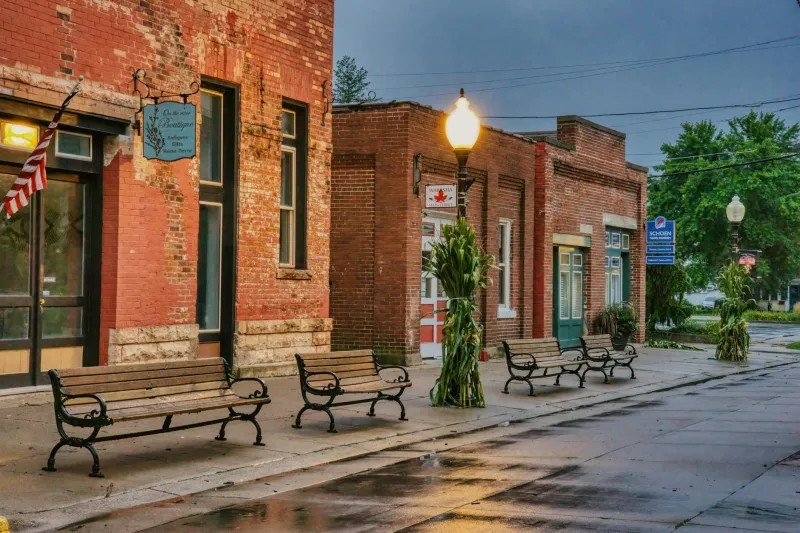
That meeting produced one of the earliest municipal building codes in Ohio — a set of standards requiring masonry construction for all commercial buildings within the town center. It was controversial. Brick cost more than timber. Some residents argued the town couldn't afford it. The people who'd chosen to stay argued, with a bluntness that apparently characterized Millhaven's civic culture, that the town couldn't afford not to.
They built in brick. And the town grew.
A Prosperity That Took Its Time
The decades between the first fire and the second disaster were, by most measures, good ones for Millhaven. The brick commercial district became a regional draw. A small manufacturing base developed around the river trade. The town built a library, a high school, and a reputation as a place that took its civic institutions seriously.
It was not a famous place. It was not a place that appeared in newspaper stories or attracted outside investment on any remarkable scale. It was, in the way of thousands of small American towns in the late nineteenth and early twentieth centuries, quietly functional — a community that worked.
Then, in the spring of 1913, the Great Flood came.
The flood of 1913 was the deadliest natural disaster in Ohio's history, killing more than 400 people across the state and destroying entire neighborhoods in cities like Dayton and Columbus. Millhaven, sitting in a river valley, was hit hard. The flood didn't burn the town, but it did something in some ways worse: it soaked it, undermined it, and contaminated it. The lower third of Millhaven — the oldest part of town, the part that had been rebuilt after the fire — was essentially uninhabitable for months.
Once again, some people left. Once again, the people who stayed held meetings.
The Second Rebuilding
The response to the flood was, in retrospect, visionary in ways that were probably not obvious at the time. Millhaven's city council, working with a young civil engineer named Thomas Adler who had come to town to assess the damage and ended up staying for thirty years, made the decision to relocate the lowest-lying residential streets entirely and redesign the flood-vulnerable sections of town around a small park system that would act as a natural buffer.
This was not a popular decision in the short term. It required displacing families from land they'd owned for generations. It required money the town didn't easily have. It required a degree of collective trust in institutional planning that was, frankly, a lot to ask of people who'd just watched their homes fill with water.
But it worked. The redesigned lower town became, over the following decades, both more flood-resistant and more livable. The park system attracted residents. The relocated streets, rebuilt with better infrastructure, supported a new wave of small commercial development. Millhaven grew again.
The Wound That Took Longest to Heal
The third catastrophe was slower and, in some ways, crueler than fire or flood. It arrived in the early 1980s in the form of economic collapse.
The manufacturing base that had supported Millhaven through the mid-twentieth century began contracting in the 1970s and effectively disappeared by 1983. The town's largest employer — a mid-sized parts manufacturer that had operated on the river for decades — closed its doors in the spring of that year, eliminating nearly 400 jobs in a community of under 5,000 people. Within two years, the main commercial street had lost a third of its businesses. The population began declining for the first time in the town's history.
This kind of wound doesn't have a dramatic moment of reckoning. There's no fire to point to, no flood line on the wall. It's just a slow erasure, a town watching itself thin out, a generation of young people leaving for places where the jobs are.
What saved Millhaven — and "saved" is not too strong a word — was a combination of stubbornness and adaptation that by this point seemed almost characteristic of the place.
A group of residents, many of them women who'd been active in community organizations for years, began in the mid-1980s to systematically recruit small businesses, artisans, and light manufacturers to the empty storefronts and industrial spaces the collapse had left behind. They leveraged the town's historic brick district — preserved, ironically, by the post-fire building code of 1871 — as an asset. They applied for historic designation. They organized a farmers market that became, over time, a genuine regional draw.
It was unglamorous work. It took years. It did not produce a single dramatic turnaround moment.
What Millhaven Knows
Today, Millhaven has a population slightly larger than it had before the manufacturing collapse, a downtown that draws visitors from across the region, and a civic culture that still — by the accounts of people who've moved there from larger cities — operates with an unusual degree of collective seriousness.
The town has been studied by urban planners, written up in regional history journals, and occasionally cited in discussions about small-town economic resilience. Most of its residents seem mildly bemused by the outside attention.
What Millhaven's story actually illustrates is something that gets lost in the national conversation about American resilience, which tends to focus on individual heroes and singular moments of triumph. Community resilience is different. It's slower, less photogenic, and built from thousands of small decisions made by people whose names don't end up in history books.
It's the person who stays when leaving would be easier. The council member who votes for the expensive brick requirement. The engineer who decides to put down roots in a flood-damaged town. The group of women who spend a decade recruiting businesses one by one to a street that used to be full.
Millhaven burned. It flooded. It hollowed out. And each time, enough people decided it was worth saving to make saving it possible.
That's not a miracle. That's a choice. And it's a choice that, across the long arc of American history, turns out to be more common than we usually give ourselves credit for.